

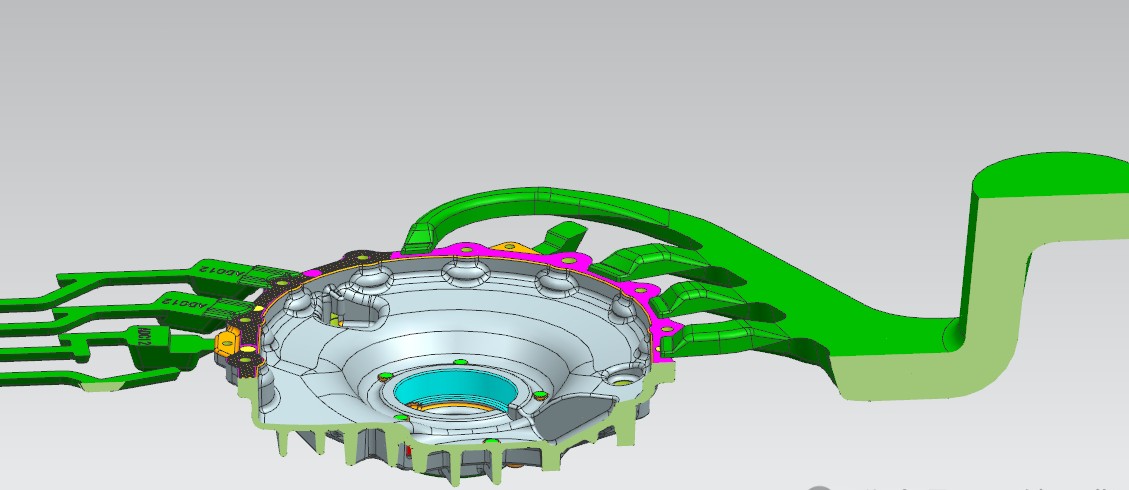
The six principles of gate design for die-casting molds are the core guidelines for controlling filling, reducing defects, and ensuring casting quality and mold life:
1、 Priority given to thick walls, smooth pressure transmission
The sprue must be prioritized at the thick wall/hot joint of the casting, allowing pressure and shrinkage to directly act on the areas prone to shrinkage, greatly reducing porosity and shrinkage. It is important to note that the sprue design at the hot joint has certain technical requirements.
Avoid the gate facing the thin-walled junction area to prevent premature solidification, gas entrapment, and cold insulation.
2、 Downstream guidance, less impact and less erosion
The flow of molten metal should follow the contour of the mold cavity, avoiding direct impact on the core, cavity walls, and inserts as much as possible to reduce the risks of erosion, mold sticking, and core displacement.
The flow channel is simple, with few detours and sharp corners, and transitions with circular arcs to reduce pressure loss and eddy currents.
3、 Size matching, thin mouth fast charging
The thickness of the sprue must be less than the wall thickness of the casting, usually taken as 1/3 to 2/3 of the wall thickness, with a maximum not exceeding 1/2, to ensure rapid solidification and easy removal. Existing structural components are excluded and have different design dimensions.
The cross-sectional area is matched according to the filling speed, flow rate, and filling time. Thin walled parts use thin gates (high flow rate), and thick walled parts use slightly thicker gates (smooth filling). The basic requirement is to achieve atomization state for filling.
4、 Deep first, then shallow, exhaust priority
The gate guide metal liquid first fills the deep cavity and difficult to exhaust area, and then pushes it towards the parting surface and exhaust groove to avoid sealing the exhaust channel. (This design scheme varies depending on different products and functional requirements)
Cooperate with the overflow groove and exhaust groove to discharge gas and slag from the end of the liquid flow, reducing porosity and slag inclusion.
5、 Balanced filling, multiple watering balance
The first mock examination with multiple cavities or complex structure adopts balanced runner to ensure consistent flow rate, pressure and filling time of each gate and synchronous filling.
Multiple gates should be used to avoid liquid flow reversal and gas entrapment. If necessary, guide blocks should be used to control the direction of convergence.
6、 Easy to cut and clean, without damaging the appearance
The position and form of the gate are convenient for subsequent cutting (such as side pouring, hidden pouring, and spot pouring) to avoid damaging the surface and critical dimension surfaces of the casting.
It is strictly prohibited to install sprues in areas with high precision and deformation requirements to prevent thermal effects and cutting marks.
Six principles of shorthand mnemonic
Thick walled mouth, downstream less flushing, thin mouth fast filling, deep first and shallow later, balanced filling, easy to cut and clean